
Guide
How to dispose of a washing machine in Brussels
A washing machine is heavy, wet inside and classed as electrical waste, so it cannot simply go out with the rubbish. These are the legal routes in Brussels, how to get the machine ready, and which route fits which situation.
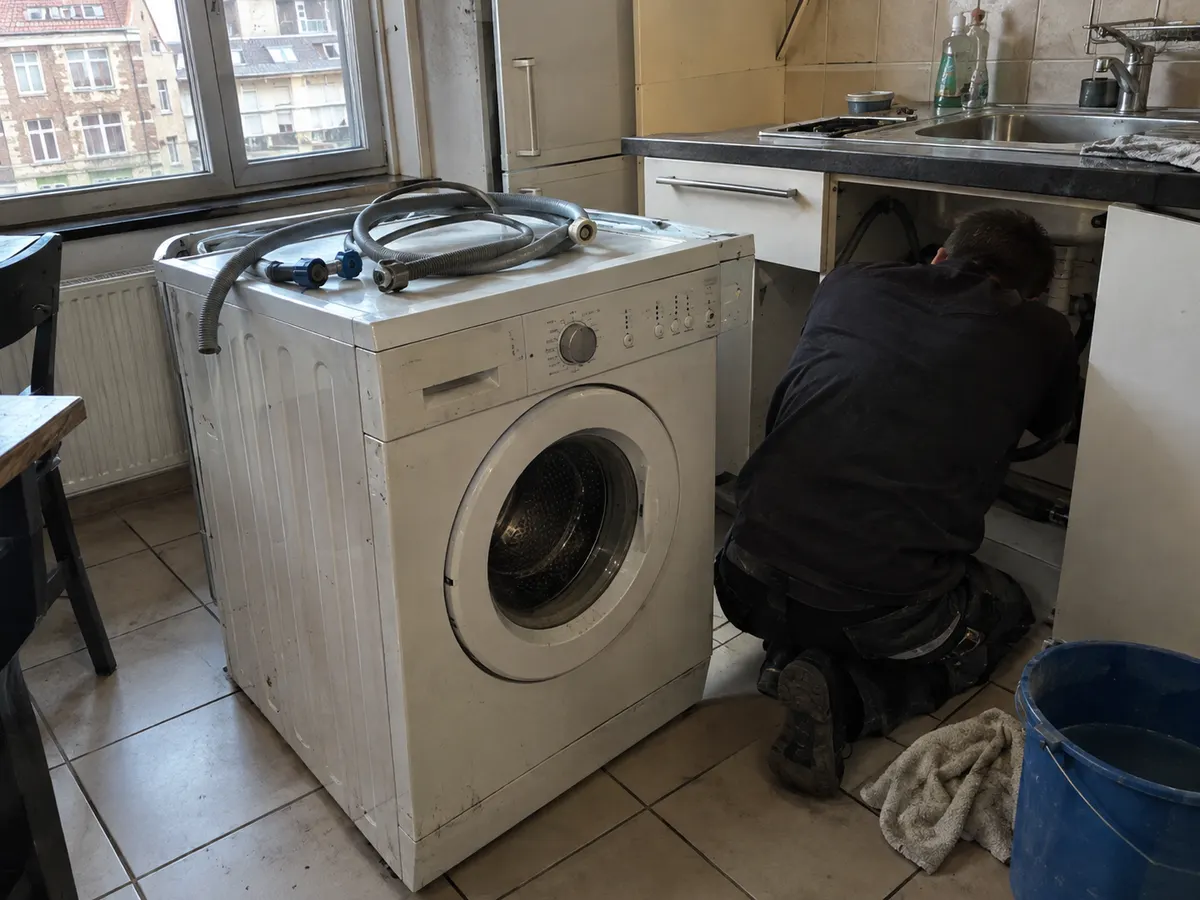
To dispose of a washing machine in Brussels, you either hand it back to the shop when you buy a new one, drive it to a Recypark yourself, or have it carried out by a clearance crew together with the rest of what is leaving. All three routes end in the same place: a registered recycling circuit for electrical appliances, run under the Recupel system. What differs is who disconnects the machine, who carries 60 kilos or more down the stairs, and who drives it away.
Can a washing machine go out with bulky waste in Brussels?
Not with the household bags, and never left on the pavement on a random day. A washing machine is waste electrical and electronic equipment (DEEE in French, AEEA in Dutch), and in Belgium it belongs in the Recupel collection system, which you already paid into through the Recupel contribution when the machine was bought new.
A machine standing on the kerb without a booked collection is treated as an illegal dépôt, and Brussels communes now chase those hard: our guide to illegal dumping fines in Brussels explains what that costs. If you book the regional bulky-waste pickup, ask explicitly whether large appliances are included before you carry anything down, because the mobile collection points run with the communes do not accept large appliances at all.
Option 1: give the old machine back to the shop
When you buy a new washing machine, the seller has to take back your old, similar appliance free of charge, whatever the brand and wherever you bought it. This take-back obligation applies to online orders too: a web shop that delivers a new appliance must offer a way to take the old one back.
Two practical points decide whether this works for you. First, the old machine has to be complete, not stripped for parts. Second, check what the delivery crew will actually do on the day: whether they disconnect the old machine, whether they carry it down from your floor, and whether there is a lift. In a modern block in Evere with a lift, a swap usually goes smoothly. In a fourth-floor walk-up, ask before you order.
Option 2: take the washing machine to a Recypark
The regional Recyparks run by Bruxelles-Propreté accept small and large household appliances free of charge from Brussels residents, as part of a sorted load. You bring your identity card or a proof of address, the vehicle has to stay under 3.5 tonnes, and you unload it into the right container yourself.
That last part is the problem with a washing machine. It does not fit in most car boots, it has to travel upright or on its back with the drum secured, and two people are needed at both ends. Our Recypark guide lists which park takes which vehicle and how much volume you can bring per day.
How to disconnect and drain a washing machine before it leaves
Close the water tap, unplug the machine, then drain the water left in the pump and drain hose before anyone tips it. A machine that looks empty still holds water behind the filter, and that water ends up on your floor, on the stairs or in the van.
- Turn off the tap behind the machine and pull out the plug.
- Open the small flap at the bottom front, put a shallow tray and towels underneath, and unscrew the pump filter slowly. Some machines have a thin emergency drain tube next to it.
- Unscrew the inlet hose from the tap and lift the drain hose out of the siphon or sink. Let both drip into a bucket.
- Tape the door shut and tape both hoses and the cable to the back of the machine so nothing catches on a banister.
Tip: leave the old machine disconnected but in place, and photograph it with the route out of the flat. That is enough for a crew to plan the carry.
Getting a washing machine down a Brussels staircase
You carry it with two people and a strap, never alone and never by the door or the top panel. Front-loaders hide a concrete counterweight inside, so most of the weight sits low and to the front, and the machine tips forward on a staircase if it is held wrongly.
Brussels homes make this harder than it should be. In many maisons de maître the washing machine stands in the cellar, at the bottom of a steep, narrow stone stair with a low ceiling. In converted townhouses it is often on a top-floor landing or tucked into a bathroom, with a spiral turn near the end. Appliance trolleys help on straight flights and hallways, but on tight Brussels turns the machine is usually carried by hand, step by step.
Dryers, dishwashers and the old fridge
Tumble dryers and dishwashers follow exactly the same routes as a washing machine: shop take-back, Recypark or a clear-out. Empty the water tank of a condenser dryer and clean the fluff filter; a heat-pump dryer also contains a refrigerant circuit, so keep it intact and do not try to take it apart. A dishwasher holds a little water in its sump, so drain it into a tray before it is tilted.
Fridges and freezers are a separate case because of their cooling gases. We cover them in our guide to fridge and freezer disposal in Brussels, including how long to let them defrost.
What does washing machine disposal cost in Brussels?
Shop take-back costs nothing extra when you buy a similar new machine, and the Recypark is free for household appliances, but you supply the van, the helpers and the carrying. With a crew, the washing machine is not priced on its own: we do not come out for one appliance, and the machine travels with the rest of the clear-out.
That is usually how it happens anyway. The washing machine goes when the whole kitchen is emptied at the end of a lease, when a cellar laundry is cleared, or when a flat is emptied after a move abroad. A small clear-out, such as a kitchen full of appliances and boxes or a cellar, runs €250 to €600; a full flat is a full clearance. The price is fixed from your photos and includes the stairs and the recycling. See our appliance removal service, junk removal for mixed loads, and the ranges on our pricing page.
What happens to an old washing machine after collection?
It goes to a registered processing plant in the Recupel circuit, where it is depolluted and broken down into materials. The steel casing and drum go to scrap metal, the motor gives back copper, the circuit boards are processed separately, and the concrete counterweight and plastics are separated out. Machines that still work can sometimes be picked out for reuse first, which is another reason to keep them complete and dry.
We clear kitchens and laundries across the region, from the apartment blocks of Evere to the townhouse cellars of Jette.
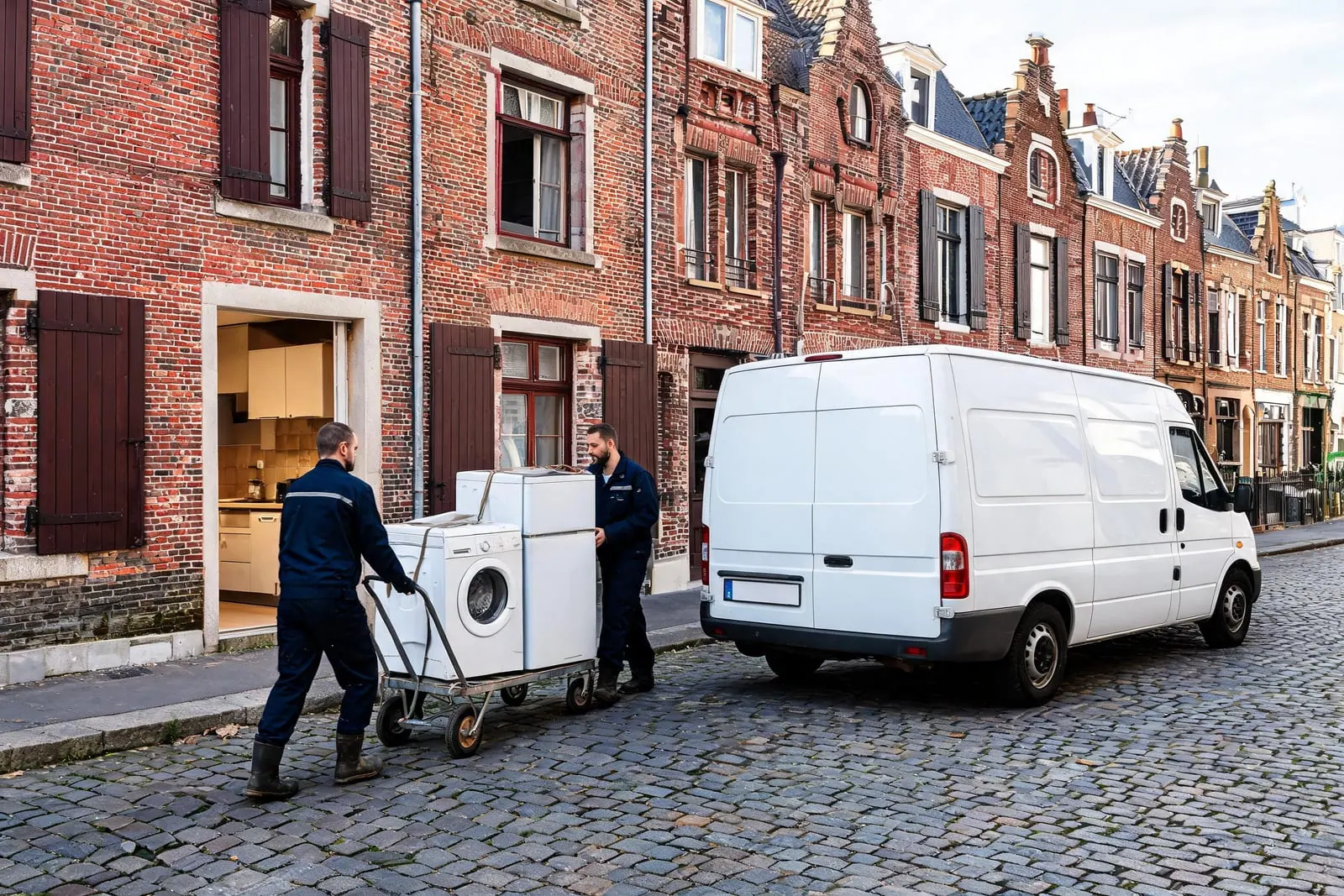
Washing machine disposal in Brussels: common questions
Does the shop have to take my old washing machine?
Yes, when you buy a similar new appliance from them. Belgian take-back rules oblige the seller to accept the old one free of charge, any brand, in store or online. It must be complete. Check beforehand whether the delivery crew carries it down from your floor.
Can I take a washing machine to a Recypark?
Yes. Brussels Recyparks accept large household appliances free of charge from residents, as part of a sorted load, with your identity card and a vehicle under 3.5 tonnes. You unload it yourself, so bring a second person. The mobile Recyparks do not take large appliances.
Will you take just my washing machine?
Not on its own. We plan crews around clear-outs, so the machine leaves with the rest: the kitchen, the cellar or the whole flat. A small clear-out starts at €250, priced from photos, carried down from any floor and recycled through the proper appliance circuit.
Do I need to drain a washing machine before disposal?
Yes. Water stays in the pump and drain hose even after the last cycle. Unscrew the pump filter at the bottom front over a tray and towels, let the hoses drip into a bucket, then tape the door and hoses before the machine is tilted.
More guides for Brussels
- Leaving Belgium: how to clear your Brussels flat before you goA realistic timeline for clearing a Brussels flat before you leave the country, from shipping and selling to the exit inventory.
- Skip hire in Brussels vs a junk removal crewPermits, signs, loading and cost: when a skip makes sense in Brussels and when a clearance crew is the better route.
- How to get rid of an old sofa in BrusselsRecypark, the regional pickup, reuse shops or a clear-out crew: the honest options for an old sofa in Brussels.
Old appliances to clear?
Send photos of the machines, the kitchen and the staircase to 0486 54 00 49 on WhatsApp. We clear them with everything else that has to go, at one fixed price, from any floor.